Troilo
1938–1965
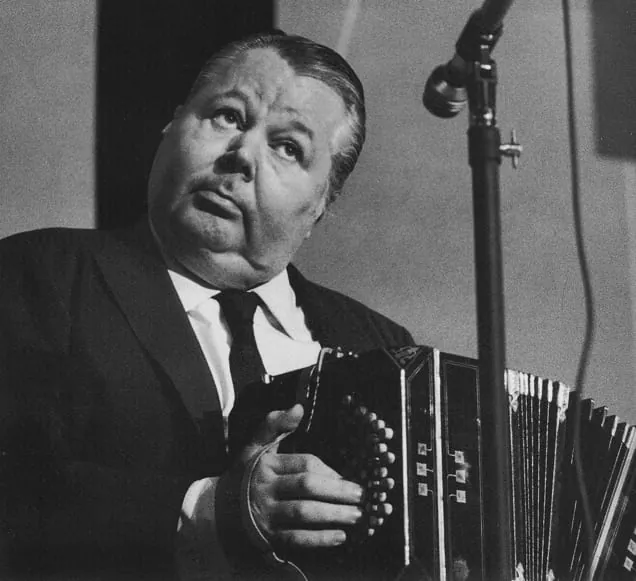
Aníbal Troilo
Aníbal Troilo (1914–1975), universally known as "Pichuco," was born in the Abasto neighborhood of Buenos Aires and became the most revered bandoneón player in tango history. A prodigy who received his first bandoneón at age ten and was performing professionally at fourteen, he played in several ensembles through the early 1930s before forming his own orchestra in 1937, debuting at the elegant Marabú nightclub. By the early 1940s, his orchestra had become the artistic center of gravity of the entire tango world.
Troilo's orchestral style represents the golden mean of tango — the perfect equilibrium between rhythm and melody, between intellectual sophistication and raw emotional power. Where D'Arienzo drove dancers with relentless rhythmic energy and Di Sarli enveloped them in elegant legato, Troilo did something more complex: his arrangements were richly layered, with prominent strings and bandoneóns working in dialogue, yet the rhythm always remained clear and inviting. His own bandoneón playing was the emotional heart of the sound — warm, expressive, with a characteristic way of breathing between phrases that gave the music a profoundly human quality. The result is music that rewards repeated listening: simple enough to dance to on first hearing, yet endlessly nuanced.
The early recordings from 1938 established the orchestra's identity, but the true golden era began with the arrival of singer Francisco Fiorentino in 1941. Their partnership, lasting through 1944, produced what many consider the greatest tango recordings ever made — "Malena," "Gricel," "Los Mareados," and "Garúa" among them. When Fiorentino departed, Alberto Marino brought a more dramatic, passionate intensity, delivering definitive versions of "Uno" and "María" through the mid-1940s. Floreal Ruiz added a poetic, introspective dimension during the same period, heard beautifully on "Romance de Barrio." The instrumentals — spanning the full career from "Milongueando en el 40" to "Quejas de Bandoneón" — showcase the orchestra's collective artistry at its finest.
At milongas worldwide, Troilo is one of the three or four indispensable orchestras. His Fiorentino-era tangos are programmed at virtually every event, and his instrumentals are prized for their depth and danceability. His music particularly rewards intermediate and advanced dancers who can feel the subtle phrasing and dynamic contrasts, though the clear underlying rhythm makes his recordings accessible at any level. Troilo composed many tangos himself — "Sur," "La Última Curda," "Barrio de Tango" — and his influence on every orchestra that followed him is immeasurable. For many, Troilo is not just a great orchestra but the very soul of tango.
Top songs
- Tinta Roja
- Milongueando en el 40
- Malena
- Sin Palabras
- Yuyo Verde