De Caro
1924–1951
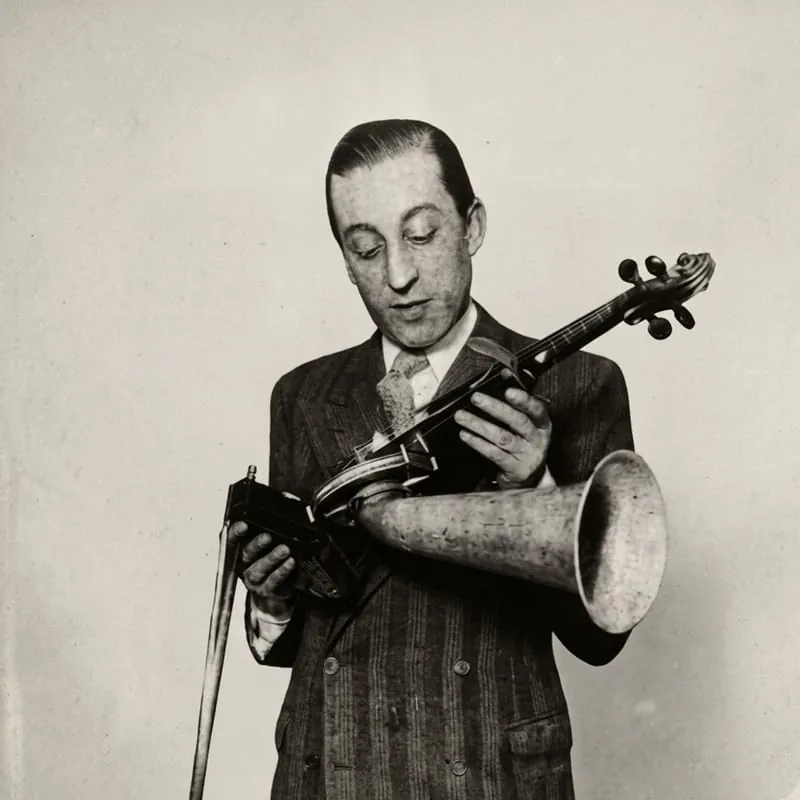
Julio De Caro
Julio De Caro (1899–1980) was born in Buenos Aires into a musical family — his father was a classically trained musician, and his brother Francisco became the gifted pianist in his sextet. Julio studied violin at the conservatory and began performing in tango ensembles as a teenager. In 1924, he formed his legendary sexteto, debuting at the Café Germinal and quickly becoming the most influential ensemble of the late 1920s. His recordings for the Brunswick and Victor labels during this period fundamentally changed the course of tango history.
De Caro's impact on tango cannot be overstated — he essentially invented the modern tango orchestra. Before De Caro, tango was rough, simple dance music of the arrabal; he brought harmonic sophistication, counterpoint, varied dynamics, and rubato, transforming it into an art form that demanded serious musicianship. His violin playing was expressive and almost classical in its phrasing, and the ensemble featured intricate interplay between the instruments rather than simple melody-over-accompaniment. Yet for all this intellectual ambition, the arrangements remained grounded in tango's rhythmic identity. His influence flowed directly into the orchestras that defined the Golden Age — Troilo, Pugliese, and many others openly acknowledged De Caro as their model and inspiration.
De Caro's most important recordings date from the late 1920s through the 1930s, the period when his revolutionary ideas were freshest and most impactful. The vast majority of the catalogue is instrumental, reflecting his emphasis on the ensemble as a collective voice. Luis Díaz was the principal vocalist during the early period, contributing recordings from the late 1920s into the 1930s with a smooth, understated style suited to the orchestra's refined character. Héctor Farrell appeared from the late 1930s onward, his most notable contribution being the spirited "Saca Chispas." The instrumentals are the true heart of the catalogue — "Boedo," "Mala Junta," "Tierra Querida," and "El Monito" are landmarks of tango composition, and the later tribute piece "Aníbal Troilo" shows the master still composing with power and emotion.
At milongas today, De Caro occupies an unusual position: universally revered by tango historians and musicians, but rarely programmed for dancing. The early recording quality, slower tempos, and intellectual complexity of his arrangements make his music more demanding than most Golden Age orchestras, and many dancers find the recordings difficult to connect with on the social dance floor. However, adventurous DJs who understand tango history occasionally program De Caro to add depth and variety — "Saca Chispas" and a few of the more rhythmically accessible instrumentals can work well in the right context. His significance is ultimately as the father of modern tango orchestration, the visionary whose ideas made the entire Golden Age possible.
Top songs
- Mi Dolor
- Aníbal Troilo
- Catamarca
- Maipo
- Mala Junta