Lomuto
1931–1944
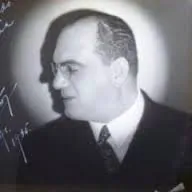
Francisco Lomuto
Francisco Lomuto (1893–1950) was born in Buenos Aires and studied piano formally, becoming one of the first tango musicians with serious conservatory training. He formed his first ensemble in the early 1920s and began recording prolifically for the RCA Victor label, establishing himself as a reliable, professional orchestra leader during the transition from the Guardia Vieja to the Golden Age. Lomuto was also a notable composer, and his orchestra served as an important bridge between the older, simpler tango style and the more sophisticated arrangements that would define the 1940s.
Lomuto's orchestral style is warm, straightforward, and pleasantly melodic — neither as rhythmically aggressive as D'Arienzo nor as harmonically refined as Troilo, but occupying a comfortable middle ground that reflects his transitional era. His arrangements have a slightly old-fashioned charm, with clean rhythms, gentle string melodies, and a steady, unhurried pulse that makes his music easy to dance to. The vals arrangements are particularly effective, with a natural spinning quality, and his milongas have an honest, earthy energy. The overall character is unpretentious and genial — music that doesn't demand attention but rewards it with consistent warmth and danceability.
Lomuto's recording career stretched from the late 1920s through the late 1940s, encompassing both the pre-Golden Age and Golden Age periods. Fernando Díaz was the first important vocalist, singing with the orchestra from the late 1920s through the early 1940s, his straightforward delivery well-suited to the ensemble's no-frills approach. Jorge Omar became the defining voice from the mid-1930s onward, bringing greater polish and emotional expressiveness — his versions of "Nostalgias," "Mano a Mano," and "A la Gran Muñeca" are the orchestra's finest vocal recordings, with Omar's warm, clear tenor giving Lomuto's arrangements their greatest emotional depth. Alberto Rivera contributed recordings during the mid-1940s, and the substantial body of instrumentals spans the full career, providing a rhythmically reliable foundation for the catalogue.
At milongas today, Lomuto occupies a supporting role — a useful alternative to the major orchestras that allows DJs to add variety without sacrificing danceability. His vals recordings are perhaps his strongest suit for programming, and pieces like "Salud, Dinero y Amor" and "La Melodía de Nuestro Adiós" are genuine crowd-pleasers. The tango recordings with Jorge Omar are effective in the more relaxed portions of an evening, and his milongas provide honest, rhythmic options. Lomuto's accessible, straightforward style makes his music welcoming for all levels, though his unpretentiousness means he is less likely to generate the floor excitement of a Di Sarli or D'Arienzo tanda. For DJs seeking to broaden their repertoire beyond the canonical orchestras, Lomuto offers reliable, warm, danceable music.
Top songs
- Quiero Verte una Vez Más
- Mano a Mano
- A la Gran Muñeca
- Nostalgias
- Dímelo al Oído