Laurenz
1937–1947
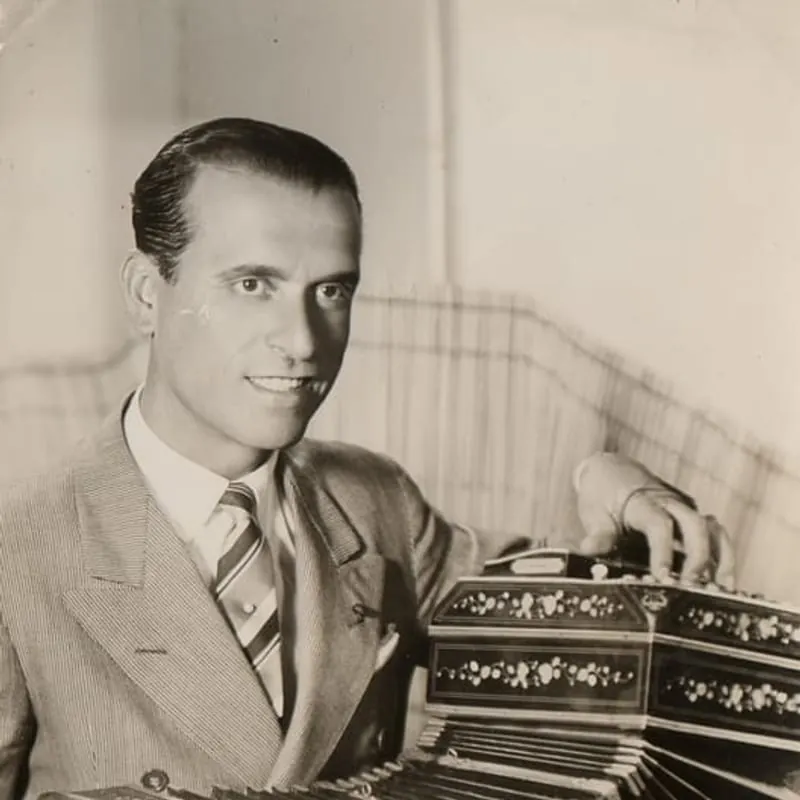
Pedro Laurenz
Pedro Laurenz (1902–1972) was born in Buenos Aires and became one of the greatest bandoneón players in tango history. A student of the legendary Pedro Maffia, Laurenz played in Julio De Caro's groundbreaking orchestra during the late 1920s and early 1930s — the ensemble that intellectualized tango and elevated it from dance-hall entertainment to a sophisticated art form. In 1934, he left to form his own orchestra, bringing with him De Caro's emphasis on musical craftsmanship and his own virtuosic bandoneón technique. His first recordings appeared in 1937, and he quickly established one of the most musically refined ensembles of the Golden Age.
Laurenz's orchestral sound is driven by his extraordinary bandoneón — warm, expressive, and technically brilliant, with a singing quality that gives his arrangements an unmistakable voice. Unlike Biagi's piano-centered orchestra or D'Arienzo's rhythm-first approach, Laurenz places the bandoneón at the emotional center, and its lyrical phrasing shapes every arrangement. The overall style bridges the intellectual tradition of De Caro with the accessible danceability of the Golden Age mainstream — arrangements that are musically sophisticated yet never lose their rhythmic clarity. The milonga recordings are particularly distinctive, with a robust, driving character anchored by the bandoneón's powerful bass register, while the vals recordings have a warm, spinning elegance. The orchestra's tone is rich and full, with a warmth and humanity that reflects Laurenz's own deeply musical personality.
Laurenz's recording career spans from 1937 to the late 1940s, with each vocal partnership bringing a distinct character. The earliest recordings featured Héctor Farrell, whose brief but impactful tenure produced the iconic "Milonga de Mis Amores" — one of the most beloved milongas ever recorded. Juan Carlos Casas became the first major vocal partner from the late 1930s through the early 1940s, his clear, emotive voice perfectly suited to Laurenz's musical arrangements on gems like "Mascarita," "Amurado," and "De Puro Guapo." The defining vocal era arrived with Alberto Podestá in 1942, whose smooth, heartfelt voice elevated the orchestra to its artistic peak — the recordings from this period, including "Recién," "Nunca Tuvo Novio," "Flores del Alma," "Todo," and "Garúa," are among the finest in all of Golden Age tango. Carlos Bermúdez and Jorge Linares contributed recordings in 1944, including the beloved vals "Mendocina." The instrumentals, from "Arrabal" to the later "Mala Junta," showcase Laurenz's bandoneón artistry at its most expressive.
At milongas today, Laurenz is a prized orchestra whose relatively compact catalogue contains an unusually high concentration of treasures. "Milonga de Mis Amores" is one of the most programmed milongas worldwide — an absolute standard that no DJ's collection can lack. The Podestá recordings are revered for their lyrical beauty and emotional depth, and a Laurenz-Podestá tanda is a highlight of any well-programmed evening. The Casas recordings offer a slightly more rhythmic, spirited alternative for different moments. Laurenz's music rewards musical dancers who appreciate bandoneón phrasing and melodic subtlety, though the clear rhythmic foundation makes his recordings accessible to all levels. For DJs, Laurenz represents quality over quantity — a relatively small but extraordinarily rich repertoire that punches far above its numerical weight.
Top songs
- Todo
- Que Nunca Me Falte
- No Me Extraña
- De Puro Guapo
- Arrabal